Chimeric antigen receptor T-cell (CAR-T) therapy has been one of the most significant breakthroughs in cancer immunotherapy over the past decade. Its potential to induce deep and durable responses—and, in some cases, long-term remission—in relapsed or refractory hematologic malignancies has reshaped treatment strategies for diseases such as lymphoma and leukemia.
To overcome the limitations of conventional autologous CAR-T therapy, the industry has introduced the concept of in vivo CAR-T generation. This approach uses intravenous administration of a vector carrying a CAR transgene to reprogram a patient’s T cells directly inside the body.
In vivo CAR-T is widely regarded as a promising next-generation cell therapy platform. It may transform CAR-T from a complex, patient-specific “living cell medicine” into a more accessible gene medicine, with the potential for faster treatment, lower manufacturing complexity, and broader patient access.
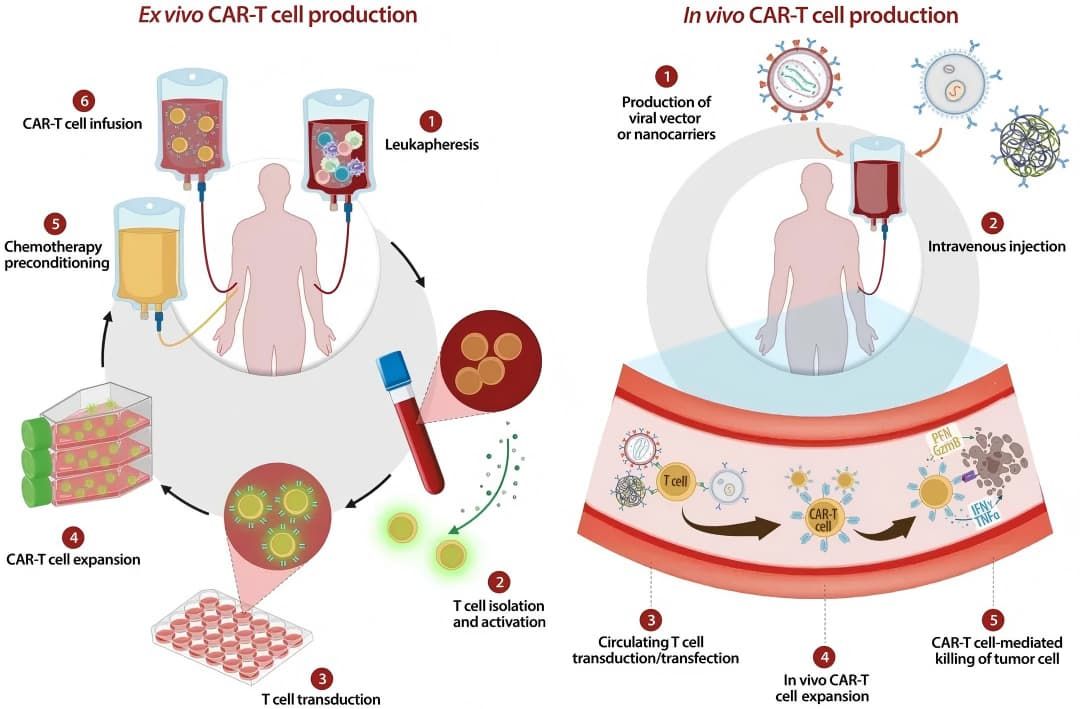
Figure 1. Comparison between ex vivo and in vivo CAR-T cell therapy.
Lentiviral vectors are commonly used gene-delivery vehicles for in vivo CAR-T therapies. Most are derived from HIV-1 and have undergone multiple generations of safety engineering, with third- and fourth-generation systems now widely used.
Nevertheless, there remains a theoretical risk that homologous recombination could generate replication-competent lentivirus (RCL). If RCL is formed, it may replicate in vivo and infect non-target cells, creating potential risks such as insertional mutagenesis and unintended immune activation.
As in vivo CAR-T technologies advance, robust safety assessment of lentiviral vectors is becoming increasingly important. RCL testing is therefore a critical component of patient-safety assurance for in vivo CAR-T products.
This article examines three key methodological considerations for RCL testing in in vivo CAR-T therapies: lentiviral envelope design, susceptible indicator-cell selection, and endpoint assay selection.
Lentiviral vectors require an envelope glycoprotein to enter target cells. The most commonly used pseudotyping envelope, vesicular stomatitis virus glycoprotein G (VSV-G), enables broad cellular tropism. However, VSV-G presents two major challenges in in vivo CAR-T applications:
It lacks cell specificity and may result in systemic off-target transduction.
Many individuals have pre-existing neutralizing antibodies against VSV-G, which may rapidly clear administered viral particles in vivo.
For these reasons, in vivo CAR-T vectors often use engineered envelope proteins to achieve preferential or specific delivery to T cells.
Envelope Type | Engineering Mechanism and Purpose |
VSVGmut | A mutated VSV-G variant designed to eliminate its native binding capability to low-density lipoprotein receptor (LDLR). |
Cocal-V-G pseudotype | Shares approximately 71.5% amino-acid sequence homology with VSV-G but may be more resistant to inactivation by human serum, potentially improving in vivo persistence. |
MxV-G | A mutated MxV-G envelope designed to reduce native infectivity toward non-T cells while retaining membrane-fusion activity. |
Nipah virus envelope proteins (G + F) | The NiV-G attachment glycoprotein is modified to eliminate interaction with its natural receptors, while the NiV-F fusion glycoprotein works with NiV-G to mediate membrane fusion. |
In vivo CAR-T vectors achieve T-cell targeting through engineered envelope proteins. If recombination results in RCL formation, the resulting virus may theoretically retain some or all of the vector’s engineered targeting properties.
RCL detection should therefore be designed to reflect realistic in vivo infection scenarios. Indicator cells should be selected based on their ability to support entry by the relevant envelope type.
Key considerations include:
Indicator cells should express the relevant target receptor associated with the engineered envelope.
Primary T cells may be used as supplementary indicator cells when appropriate.
The selected indicator-cell system should support meaningful evaluation of the actual infection risk associated with the product.
The 2024 Technical Requirements and Common Issues for Replication-Competent Lentivirus Detection, published by China’s Center for Drug Evaluation (CDE), emphasizes that an appropriate positive-control virus is essential for confirming assay sensitivity. Envelope selection is a key consideration in positive-control design.
Based on the principles outlined in this guidance, together with relevant FDA expectations, the following considerations may be applicable:
For vectors pseudotyped with VSVGmut, potential positive controls may include wild-type HIV, attenuated HIV, or recombinant conditionally replicative lentiviral vectors, subject to an appropriate biosafety and risk assessment.
For engineered targeted vectors, a positive-control virus incorporating a similarly modified envelope may be more representative in principle. However, its viral properties, risks to laboratory personnel, and environmental safety must be carefully evaluated.
Conditionally replicative lentiviral vectors may also be considered where scientifically justified and operationally appropriate.
Early communication with regulatory authorities is recommended during product development. Developers should select representative positive controls according to the actual envelope type and conduct targeted method qualification or validation to ensure that the RCL assay accurately reflects the product’s real safety risks.
The RCL testing method should be demonstrated to be suitable for the specific vector and envelope design. Core assessment elements include:
Indicator-cell susceptibility: Demonstrate that the selected cell line supports entry by viruses bearing the relevant envelope.
Viral replication capability: Confirm that RCL, if present, can be amplified effectively in the selected indicator cells.
Cytopathic effects: Evaluate whether detectable cytopathic effects may serve as supporting evidence of RCL presence.
Common endpoint assays for RCL detection include nucleic-acid testing, reverse-transcriptase activity assays, and functional protein assays. Examples include:
PCR assays targeting sequences such as psi-gag or VSV-G
Product-enhanced reverse transcriptase (PERT) assays
Functional protein assays, such as p24 ELISA
Using multiple orthogonal endpoint methods helps confirm the authenticity and reliability of test results. The 2024 CDE technical requirements state that at least two endpoint methods based on different principles should be used to mutually verify RCL detection results.
For in vivo CAR-T products, envelope proteins are often engineered or modified. Consequently, conventional PCR targets may not fully represent the relevant RCL risk. A PCR assay targeting the specific engineered envelope gene may need to be developed.
PERT and p24 ELISA may remain applicable in principle, but their suitability should be assessed for each specific vector design, product matrix, and RCL detection strategy.
BRC Biotechnology provides customized RCL assay development and testing services for in vivo CAR-T products incorporating specialized or engineered viral envelopes. Based on the specific characteristics of each client program, BRC Biotechnology can conduct in-depth scientific assessments, design fit-for-purpose testing strategies, and develop dedicated, product-specific assay methods. BRC Biotechnology has successfully supported several customized RCL testing projects. The primary difference between RCL testing for in vivo CAR-T products and conventional autologous CAR-T products lies in the engineered viral-vector envelope. Consequently, the RCL testing strategy should be tailored to the specific envelope type used in the product. In addition to applying conventional RCL testing principles, developers should consider the vector’s envelope-engineering strategy when evaluating indicator-cell suitability, positive-control selection, and PCR target design. Where appropriate, product-specific method suitability assessments and validation should be conducted to ensure that the RCL assay meaningfully reflects the product’s potential safety risks.